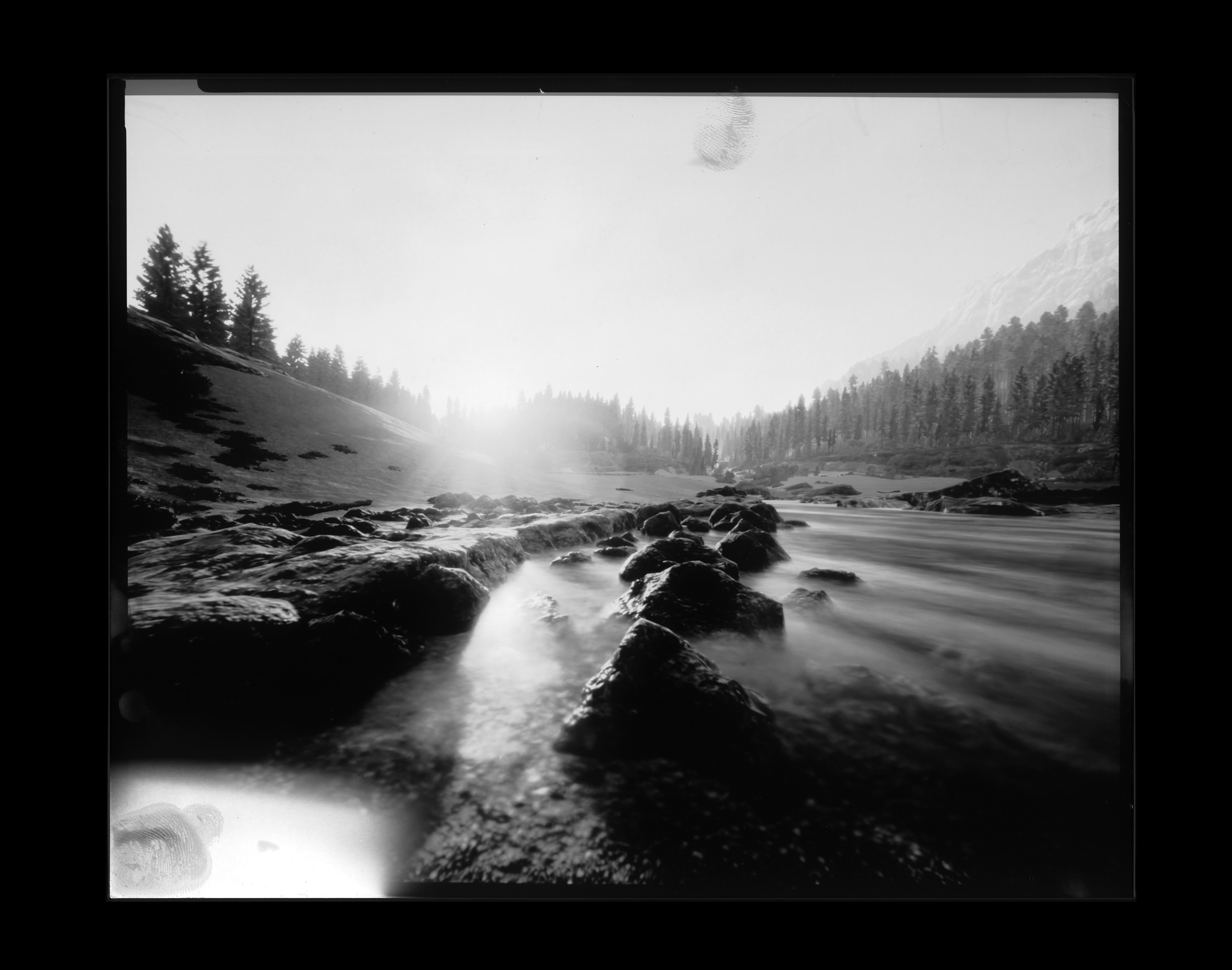
This paper/presentation reflects on Martin Newth’s photographic project Event Horizons (2022–ongoing), which explores how images are encountered, trusted, and made meaningful when their referents are no longer grounded in physical places but in computationally generated worlds. The work consists of large-format photographs of AI-generated gaming landscapes, made by pointing a 10x8 view camera at a flat 4K monitor and processing the resulting negatives using home-made photographic chemistry derived from household and garden materials, including plant matter such as dried rosemary.
The project does not treat AI-generated imagery as a substitute for photography, nor photography as a corrective to AI. Instead, it stages their meeting. The virtual landscapes are re-encountered optically, materially, and temporally through the slow mechanics of large-format photography and improvised chemical processing. Dust, uneven development, light damage, and chemical residues all become part of the image, complicating any simple distinction between the virtual and the material, the generated and the made.
The use of household materials roots these images in a specific geographical and domestic site, although one very different from the places the images depict. The home-made chemistry also draws on the growth of online communities sharing methods for ethical, non-extractive, and environmentally less damaging photographic processes.
This paper/presentation considers how these layered processes complicate the viewer’s relationship to the image. Event Horizons does not resolve questions of authenticity, authorship, or trust, but holds them open, using photography as a means to think through the complex relations between image and world, process and place, human intention and technical mediation.