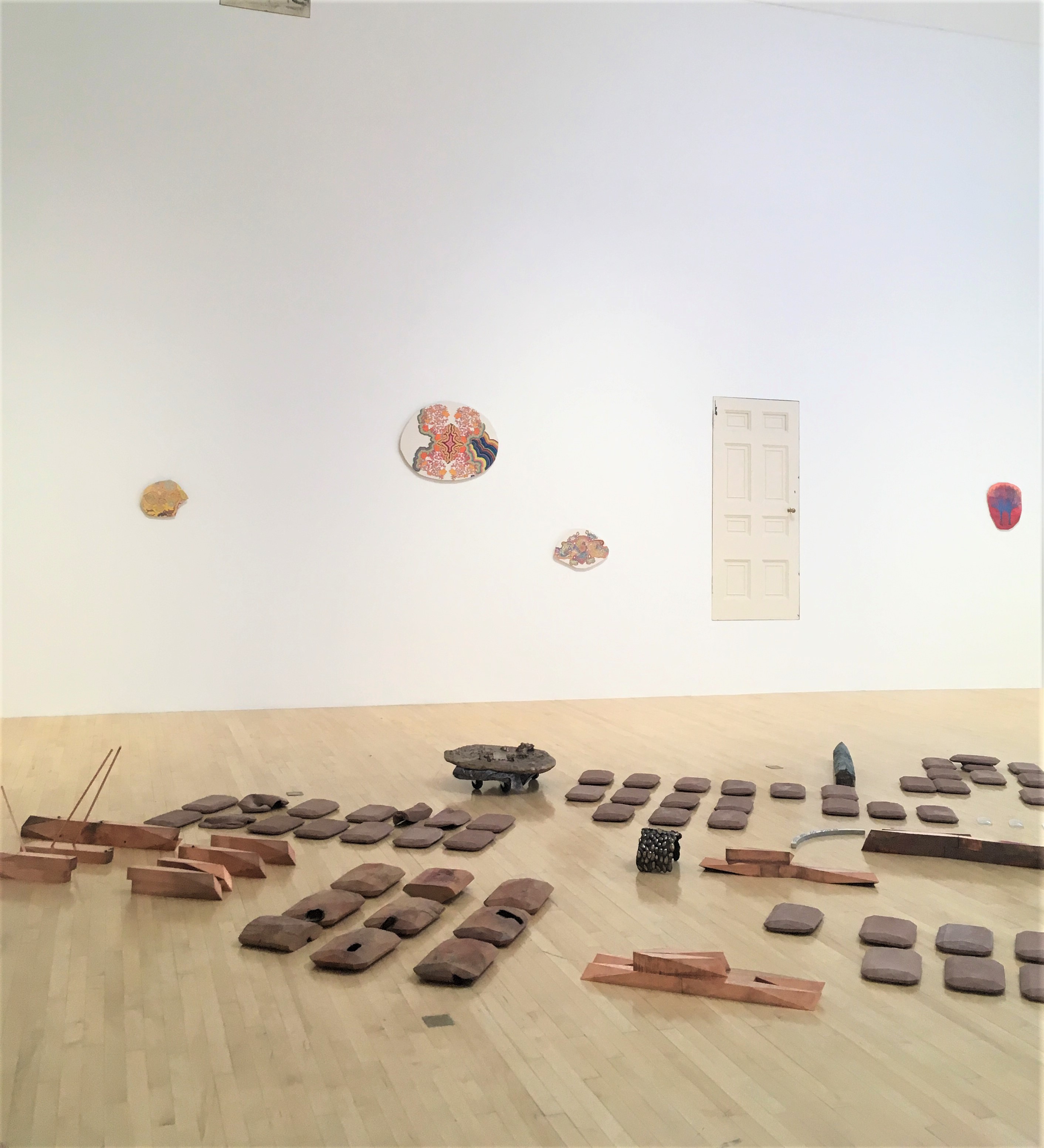
Held in Tabot Rice Gallery in Edinburgh, The Green man was a patnership between Tabot Rice Gallery, The Centre for Research Collections and Edinburgh College of Art all part of University of Edinburgh. Created by Lucy Skaer ‘The Green Man’ is an exploration of irrationality in collections. In the traditional museum, time is linear and free from ageing, Order is presented and the body is absent. Skaer asks what happens if desire, change, empathy and fallibility were instead to become the organising principles.
Throughout her practice, Skaer mines and manipulates preexisting imagery – from art and history, as well as from her own oeuvre and personal history – transforming and destabilising relationships between materials and meanings. For this exhibition, Skaer has selected items from the collections of the University of Edinburgh, inviting fellow artists to inhabit the galleries of Talbot Rice alongside her – Fiona Connor, H.D., Will Holder, Nashashibi/Skaer and Hanneline Visnes.
Visnes Contribution to the exhibition was 10 Oil paintings.
The body paintings presented at this exhibition are descriptions of forms, some of these natural forms like foliage and flowers as ornamental patterns. Others are focussed on objects like Egyptian figurines . The paintings themselves are objects made from fibreboard cut into various rounded shapes, suggestive of fragments – these are primed with thick gesso. Creating patterns require set rules: forms must be simplified and abstracted, repeated and mirrored. There is also set rules for the application of paint in each painting, in some the shapes are amplified by lines of different colours repeating the shape until they completely cover the surface and become patterns within the pattern (“Ardabil, Borrowed Garden”). In other paintings, like “Egyptian Cat” a figurine is described by using tiny dot like paint marks, building up the surface using a method developed from studies of Pointillism. The use of colour within all these paintings also adhere to rules, they are either opposed to each other creating agitated surfaces – or tonal, creating illusion of depth. The research questions that are embedded within these works may be described thus: Repeating the shape, and agitating the surface with colour – when will the motif disappear? If it disappears, how much more information is needed before it appears again? How is the motif altered when subjected to these methods? Is it possible, using these methods, to transform simple materials of pigment, wood and plaster into objects that embody and emanate energy?