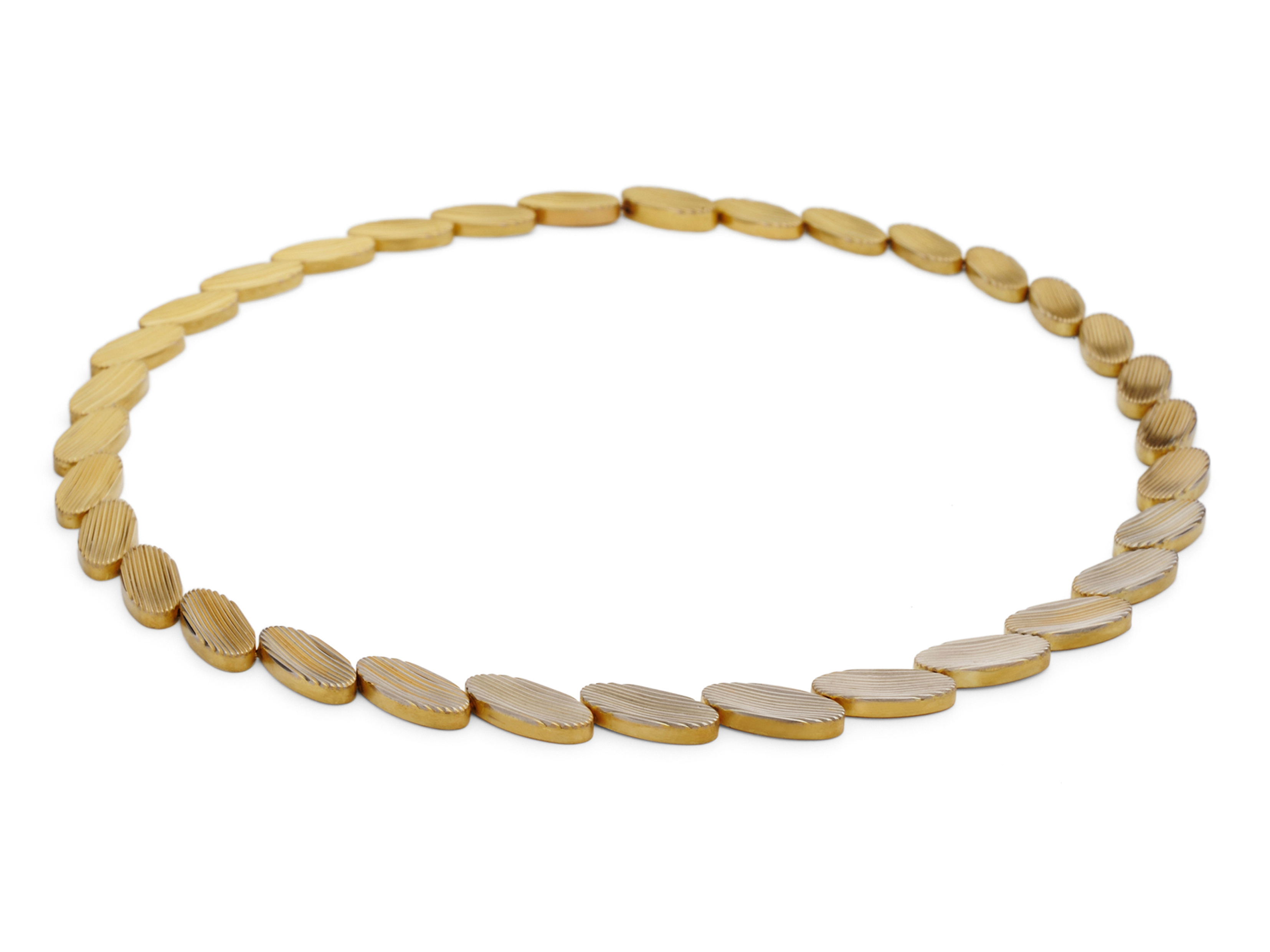
Parallel to the International Crafts Fair IHM in Munich, Galerie Handwerk had been presenting international jewelry exhibitions for years. They were linked to the special international Schmuck show at the Handwerksmesse.
The exhibition, "Jewelry All Along the Line," illustrated how, from the origins of jewelry—a line, for example, a cord, braided ribbon, or string—a wealth of variants emerged.
Artist list
Volker Atrops, Yiftah Avrahami, Alexandra Bahlmann, David Basok, Sofia Beilharz, Margherita Berselli, Doris Betz, David Bielander, Iris Bodemer, Helen Britton, Caroline Broadhead, Giovanni Corvaja, Martina Dempf, Susi Heuberger, Mirjam Hiller, Mari Ishikawa, Margit Jäschke, Steven KP, Sokoi Lamaj, Andrew Lamb, Typhaine Le Monnier, Florence Lehmann, Carolina Lutz, Andrea MAXA Halmschlager, Stefano Marchetti, Jasmin Matzakow, Oliver Meinicke, Khanya Mthethwa, Monica Nabyal, Erico Nagai, Kazumi Nagano, Farieda Nazier, Misaki Nomoto, John Parkes, Sònia Pibernat, Alessandra Pizzini, Annelies Planteydt, Mandy Rasch, Carla Riccoboni, Nicola Riess, Jacqueline Ryan, Bernhard Röck, Barbara Schrobenhauser, Juliane Schölss, Peter Skubic, Yuxi Sun, Kathrin Sättele, Ketli Tiitsar, nelly Van Oost, Marian Vanhaeren, Lisa Waup, Sibylle Wolf, Heather Woof, Pei Wu, Kun Zhang
Where does jewellery begin? The current exhibition shows how the origins of jewellery—a string—developed into a wide variety of meanings and forms that are still valid today. The use of a string is virtually the zero point of our jewellery culture and can be scientifically proven in archaeological finds. Since these beginnings in South Africa around 75,000 years ago, the use of the cord has branched out into a variety that spans cultures and times and still shapes our understanding of jewellery as wearers today, as well as shaping jewellery creation as a design theme.
We illuminate this convergence here—the global consensus—the use of a cord as jewellery. From Stone Age tools for cord production in Blaubeuren around 35,000 years ago and their use for necklaces with prehistoric beads to contemporary interpretations by international jewellery artists. The evidence of string as a jewellery object in Stone Age cultures is undoubtedly fascinating. Even more fascinating, however, is the fact that it is still used today.
Cord made from various materials
To this day, international jewellery artists examine various materials with regard to their quality for processing them into cords. The material aesthetics are appealing, but there are often important concerns behind them, such as the cultural heritage of a region, one's own origins, or the preservation of creation. Worn on the body, this cord becomes jewellery. Suddenly, the cord shifts our gaze from its aesthetic appeal to a relevant position in social discourse. Those who are aware of the symbolic classification can no longer separate the symbolic meaning from the cord, i.e. can no longer separate the idea from the object.
A connection between us
By wearing a string, you can not only make yourself and your imaginary world a theme. You can also use the string to show a connection that can be perceived by everyone. Either very concretely, by connecting yourself to a third thing, e.g. stringing a pendant and wearing it around your neck. In a figurative form, the cord may represent a spiritual connection with something invisible or with other people. Some people speak of a red thread that runs through their lives, which, although in red signal colour, is also only thought and traces our leitmotif, our turning points, and motivations for important decisions. Our emotional connections may only take place in our heads, but they carry us through life. Family ties and friendships with people accompany us on our journey, strengthen us, motivate us, and keep us going. We bear witness to them in our jewellery.
Between drawing and calligraphy
A line has a starting point, actively takes a direction, starts moving, and comes to an end. It is also a dynamic process in terms of language and gesture: we draw a line from ourselves and our body, away from ourselves and towards our surroundings, with which we connect. Depending on the tool used, this line can be sketchy with a pen or calligraphic with a brush, for example. Translated into another material, the line moves from paper up into volume, lifted into the third dimension.
The cord for rituals
A string could be infinite if we found infinite material or extended it in our minds until it goes beyond our imagination. In many spiritual values, we are a small part of a line, a link in a tradition and a larger context that leads from our past into the future and beyond. This is visualised by wearing a cord on the body that is used for different spiritual practices and rules.
No matter how different our ideas mentioned above are, they are all connected by a refreshingly clear visualisation: a simple string on the body. But again, can we not see the string as a common ground, as an element connecting our cultures? Couldn't we use the string as a starting point to recognise further similarities and connections between us all?
/ Barbara Schmidt, Leiterin der Kulturabteilung der Handwerkskammer für München und Oberbayern München 2024.