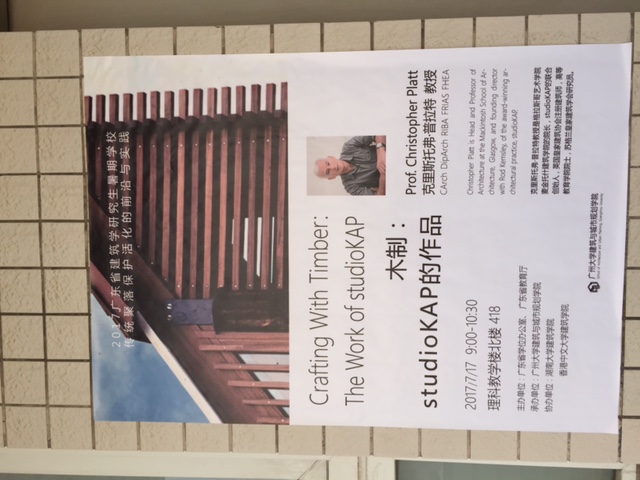
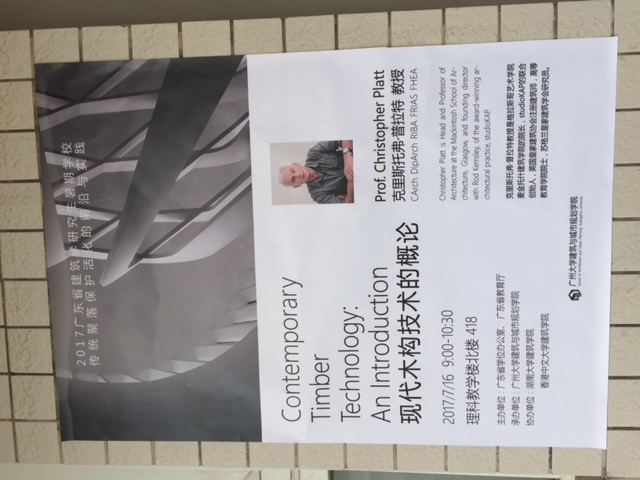
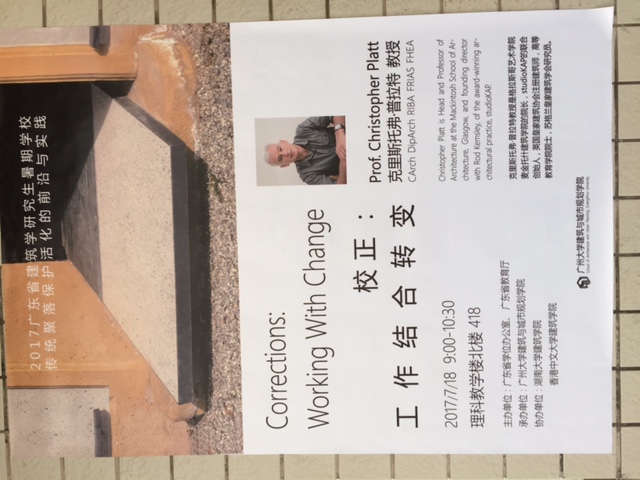
In tandem with this project which would reach fruition in August 2017 when the students designed and constructed a new 3x3x3m timber structure in the village, I carried out discussions with Professors Ling Cai and Yi Deng about the longer term research project between MSA and Guangzhou which sought to establish and implement those methodologies referred to above in tangible, physical form in the villages, built potentially by students. These also reflect similar themes to those also explored in the ‘Village Textures’ project which MSA has been involved in for the last 3 years with the international studio project with the Bauhaus Weimar, TU Wien, UCD Dublin and Federico II, Naples. This new project could be one in which these partners may also be interested in taking part.
The potential collaborative research/design proposal between Guangzhou and MSA can be briefly summarized as follows:
• To establish a contemporary timber structure system which can be applied within traditional Chinese contexts such as the Dong villages.
• A 10 year timescale project of research, community participatory practice and live build interventions by an international group of architecture students.
• Partners would be Guangzhou, MSA/GSA and possibly one other HEI with existing expertise in innovative timber technology (e.g. ETH Zürich, Dalhousie, Nova Scotia, one of the universities in Scandinavia).
• Obvious international references which have involved lengthy an immersive involvement in one place by an architect of distinction over a perioid of several decades would be Luigi Snozzi in Monte Carasso, Alvaro Siza in Portugal. Contemporary timber examples in village settings could also include the work of Peter Zumthor in Leis, Switzerland, Gion Caminada in Switzerland.
• The project could begin with a funded grant to build a series of small timber structures in the village to enthuse and engage local community in a design process and to establish a working relationship and trust.
• An initial action would be to apply for funding to set up a dedicated and kitted out laboratory in Guangzhou to test old and new structural models and to experiment with different timber systems.
This project provides a good opportunity for MSA/GSA to be part of a fascinating international experiment in historic settlement protection and development. Issues which it could explore also include:
• How to ensure the social sustainability of aging communities?
• How to ensure the protection and life-affirming further development of places of historic interest such as the Dong villages?
• How contemporary timber technology design and applications can contribute to new interpretations of the traditional architectural typologies visible in the villages?
• How participatory practice methodologies can be established and implemented to ensure the most effective and fruitful degree of community engagement?
• How the model of a student-centred full size live build project can achieve the above objectives?
• How a commercial-dominated construction industry in China can align itself to operating at a different scale and pace with a material such as timber which it seldom builds with?
Other themes which the project raises include:
• Small scale dense living with extended families.
• Traditional and contemporary family and social structures.
• Live/work models in rural settings.
• Digital tools in traditional village life.
• Spatial structures and typologies.
• Nostalgia, memory and contemporary needs.
• The significance of the vernacular as a learning tool.
• Ecology and self sufficiency in the 21st century.
• Environmental and social sustainability.
• New models of informal settlements.
• Place identity.
I brought a number of ‘props’ as illustrations for the students as part of my presentations to show the versatility and historic legacy of timber, namely:
• Volume 3 of ‘Newnes Carpentry and Joinery’ ,a UK pre war series of construction manuals which has good examples of how joinery technology was taught (and illustrated with old photographs and drawings).
• A volume of hand drawn German construction exercises from (probably) a construction apprentice at a technical college.
• A piece of Scottish Sitka Spruce.
• A 70 year-old joiner’s scribing tool (itself made of timber) which belonged to my late uncle illustrating a typical joiner’s tool from that period.
• Copies of my own hand drawn construction details of two of the projects I have designed and built and which featured in the lectures I gave as case studies.