'Plat du Jour'
Materials & Dimensions
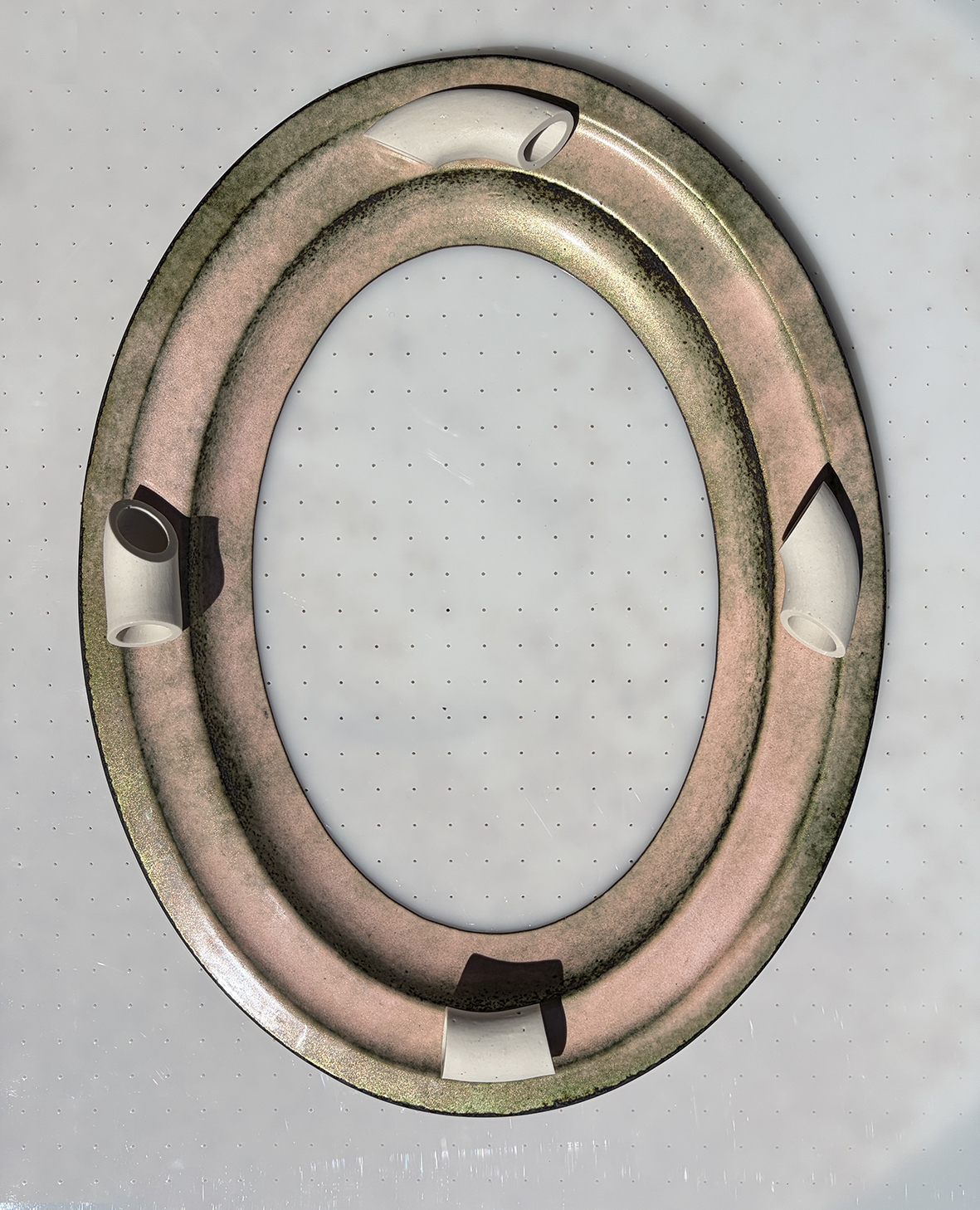
Copper, Enamel (recycled dish)
41.5 x 32 x 3.5 cm
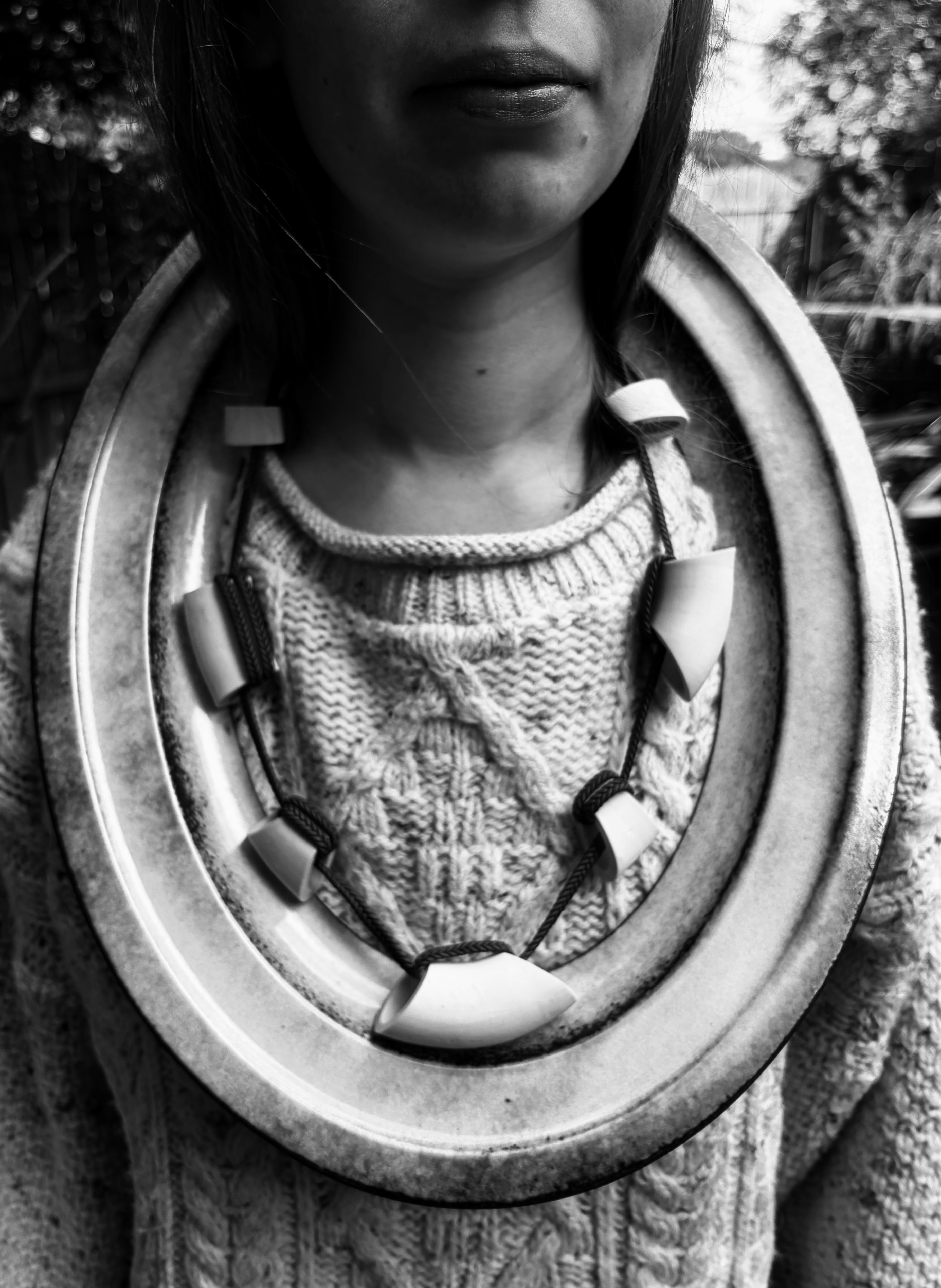
Porcelain, cord, silver 37cm length.
Porcelain units range from 8 x 3.5 x 2cm to 3 x 3 2 2 cm
'Plat du Jour' is a one -off unique practice research artefact that interrogates and embodies the intersections of material culture, anthropological lineages of adornment, and the socio-political narratives embedded in historical domestic objects.
Exhibited as part of a small group of international artists to show at the inaugural Manchester Jewellery Week 2026 under the theme “I Wanna Be Adorned,” the work functions as a critical material intervention into the domestic rituals of 19th- and 20th-century British imperialism and an elite dining culture.
The research uses a practice-led methodology to disrupt established craft hierarchies and explore narratives of consumption and deep-time mortality.
A historical, colonial-style enamelled copper serving plate was structurally modified, using a traditional piercing saw to create an oval aperture, and resurfaced with vitreous enamel ( a material connected to both table and kitchenware and jewellery) transforming a rigid utilitarian vessel into an active, wearable pectoral artifact.
The cut edges were meticulously burnished, serving as a material metaphor for a conceptual “clean break with history” and the practice of re-sue and reframing.
This altered metalwork is juxtaposed with extruded and hand finished porcelain elements formed as anatomical bone fragments, suspended from a high-contrast red cord. By utilising bones—historically the earliest, most primal materials of prehistoric and ethnic jewellery—the piece contrasts deep-time human markers of identity against past rigid class structures, signified by the Sheffield plate they are laid on.
The artefacts accompanying artistic statement was; “If our bodies body are vessels, then they are a temporary serving plate for life. When the feast is over, all that remains is the story, the spirit and the bones.”
Conceptually, Plat du Jour advances a novel phenomenological framework that reframes the human body itself as a transient material vessel—a temporary serving plate for life. The artefact demonstrates that when the societal or physical feast concludes, all that remains is the story, the spirit, and the bones. By shifting the role of the "client" demanding adornment from the human body to the domestic object, this output extends the boundaries of contemporary wearable art, offering new insights into how craft can transcend the boundary between static museum critique and active, somatic engagement with historical memory.
The practice-based research explored how traditional metal-smithing interventions can be applied to an archival object—specifically the act of piercing, burnishing and enamelling a piece of 19th/20th C Sheffield plate —to redefine a contemporary 21st C narrative
What conceptual insights are generated when material evidence of consumption (porcelain "bones") are structurally integrated back onto the domestic vessel that historically facilitated that very consumption?